While most Canary Islanders did not have much in terms of worldly positions to bring to the New World, many brought with them the intangible beliefs, customs, stories, and legends from their ancestors. These elements have folklore have been passed down through the centuries where they were joined by other customs in Louisiana. The following examples provide an introductory glimpse into Isleño life and the traditions of the community.
One of the most popular stories told in the Isleño community are the cuentos de Quevedo (meaning ‘tales of Quevedo’). In general, these stories fit a particular form with the protagonist Quevedo pitted against “the King” and his soldiers. Quevedo is often challenged by the King and his men to perform impossible feats. In response, Quevedo uses his wit and intelligence to best the King in humorous and outrageous ways.
The character “Quevedo” is a reference to the seventeenth-century writer Francisco Gómez de Quevedo y Santibáñez Villegas who was born in Madrid, Spain. Quevedo was an adherent to conceptismo which is a style of writing which compares concepts through wordplay and metaphors among other techniques. Often puns, irony, and paradoxes were utilized in this form of writing. It seems evident that the style used in the cuentos de Quevedo is very much inspired by Francisco de Quevedo himself.
At one point many hundreds of variations of these stories must have existed. Unfortunately, very few stories have ever been written down as the cuentos de Quevedo were a strictly oral tradition. One of the most famous stories is simply referred to as Como Quevedo dijo a la reina que era coja (‘How Quevedo Told the Queen She Was Lame’). This story was even recited to former Prime Minister of Spain Adolfo Suárez by Julia “Sha” (Melerine) Schiel and recorded in the documentary Mosquitos and High Water by the Center for New American Media:
| Spanish Transcription | English Translation | |
|---|---|---|
| Cuando la reina era coja… Y el rey le dice a Quevedo, “No le puede decir a mi reina que es coja.” |
When the queen was lame... And the King says to Quevedo, “You can't tell my Queen she is lame.” |
|
| Él le dice “Sí señor, le puedo decir que es coja.” |
He says “Yes sir, I can tell her that she is lame.” |
|
| [El rey dice] “No, no...” |
[The King says] “No, no...” |
|
| Él [Quevedo] fue y cogió un ramo de rosas. Le trajo a la reina y le dijo “Señora, escoja.” La reina cogió su rosa—y ahí le dijo que es coja. |
He [Quevedo] went and picked a bouquet of roses. He brought it to the Queen and said “Madam, you pick.” The Queen took her rose—and there he told her that she’s lame. |
|
| [El rey le dijo] “¡Oh no! No le puede decir—” |
[The King said] “Oh no! You can't tell her—” |
|
| [Quevedo dijo] “Sí señor, le dije que era coja.” | [Quevedo said] “Yes sir, I said she was lame.” |
This story famously uses a pun where es coja means ‘lame’ and escoja means ‘choose’ or ‘pick’. A version of the story recorded by Samuel G. Armistead in his work The Spanish Tradition in Louisiana, includes an additional quip from Quevedo that he will tell the Queen that she is lame and that she will take great pleasure in hearing this. The structure and content of these stories generally differ depending on the person retelling the story. Additionally, since the cuentos de Quevedo were never written down, elements of certain stories have undoubtedly changed over time. Despite this, the legendary wit of Quevedo continues to humor Isleños after centuries.
Become a member. Join today!
A particularly prevalent element in the repertoire of Isleño folklore must certainly be la luz de los árboles (meaning ‘the light of the trees/branches’) also known as la luz del árbole, la luz del agua, or la luz del lago. The luz de los árboles was described as an orb of light or fire which would generally appear in the marshes of St. Bernard and Plaquemines Parishes but also along the shores of Lake Borgne.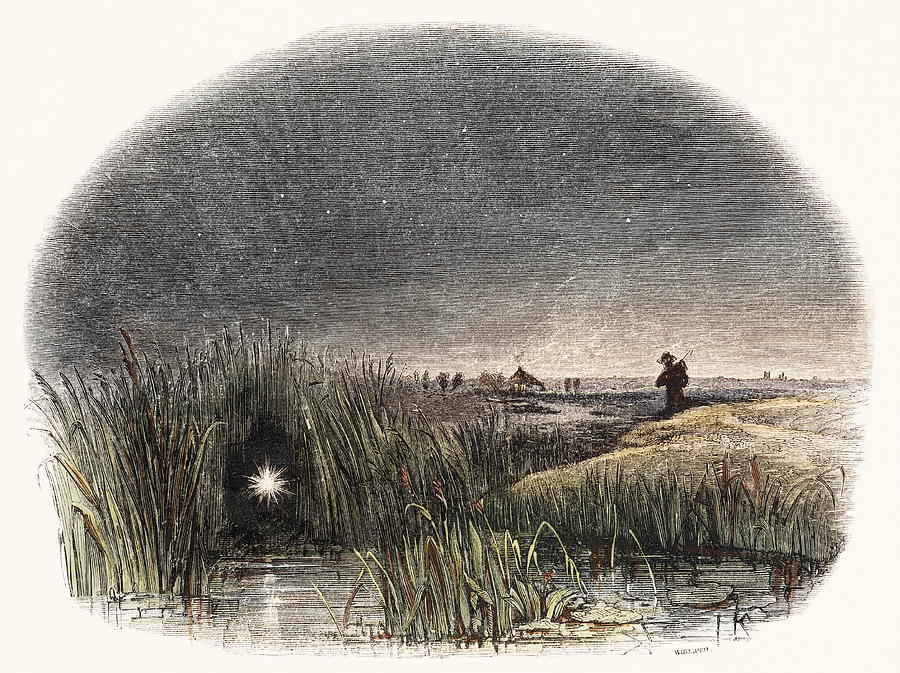 This light would be seen traveling across the marsh grass, often described as “bouncing”, or hovering amongst trees. Occasionally the luz de los árboles would even be seen in the Isleño communities themselves.
Isleños who have seen this light have often been terrified of the experience and do not know what to think. Some stories tell of the light pursuing Isleños in their boats or even approaching them on their front porches. The luz de los árboles was often seen as something supernatural and a bad omen. For example, it has been said that if the light hovers over the home of a community member, tragedy will befell the family such as an unexpected death.
Similar descriptions of supernatural lights over marshes, bogs, or wetlands can be found in nearly every culture. In English, the phonenomon is most often described as will-o’-the-wisp. In Latin America, this phenomenon is referred to by similar names and is largely regarded as a bad omen. In Louisiana, French speakers have also witnessed this light which they call the “feu follet”. Today, it is generally believed that these lights are caused by the ignition of flammable marsh gases.
Another facet of interest in Isleño folklore is the belief in witchcraft known in Spanish as brujería (broo-heh-REEAH). Many beliefs in St. Bernard Parish can be traced back to the Canary Islands, the Iberian Peninsula, and Europe as a whole.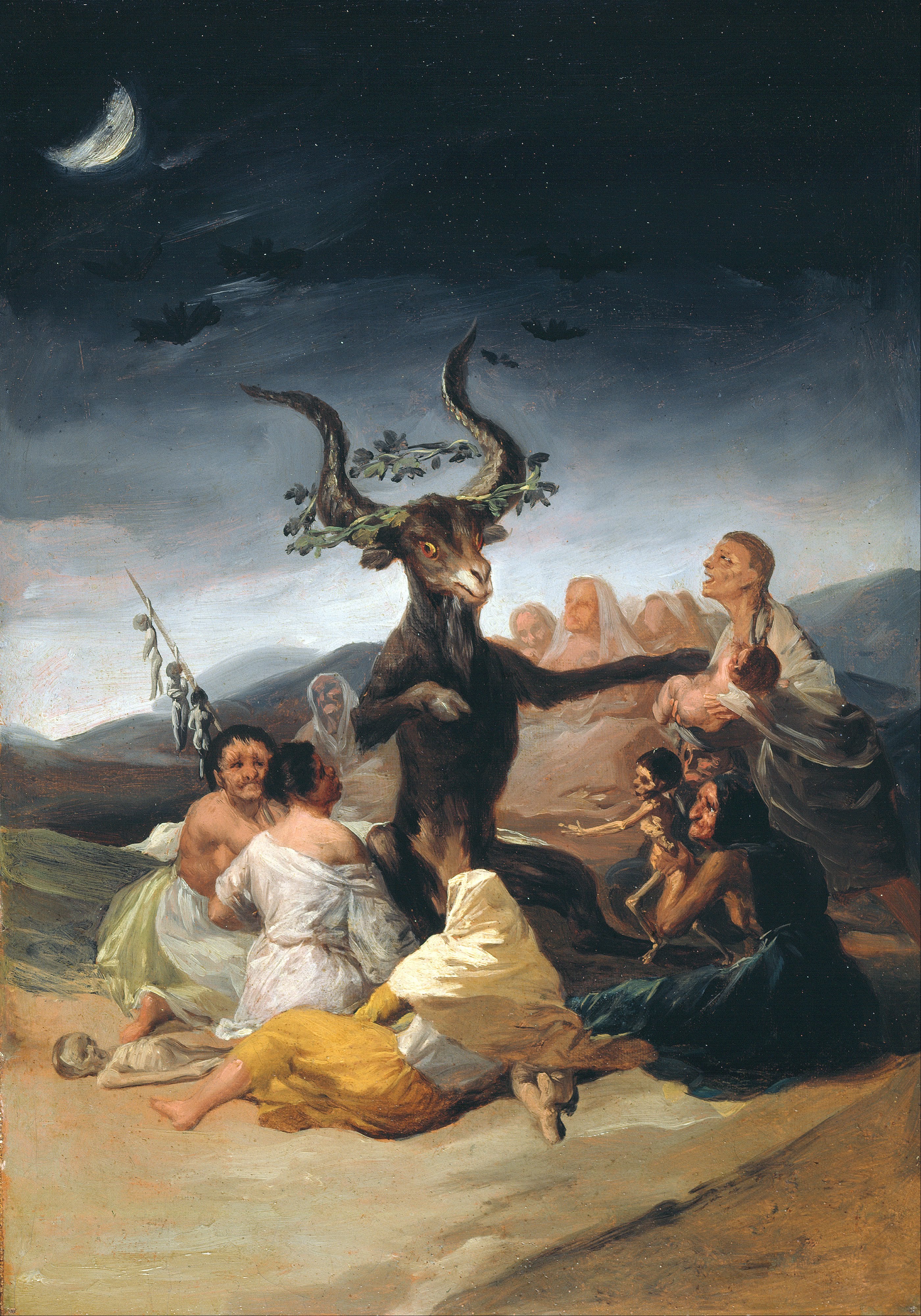 Elements of brujería have also made their way into Latin America where they have even been influenced by indigenous beliefs. Within the Isleño community, prayers and supernatural intervention have traditionally been relied upon for cures to ailments, solutions to trying times, and even as defences against natural forces. The Catholic faith also played an important role in the daily lives of Isleños. Many stories of brujería in Louisiana possess some key motifs which are shared among other cultures.
Variations of stories tell of how brujas (BROO-hahh, meaning ‘witches’) would secretly gather during the night. After this gathering, the witches would then “ride in the night” generally on a boat. These stories often tell of incredible feats such as traveling to Cuba or Spain and back in a single night. It would often be discovered the next morning that these brujas would bring back flowers or vegetation native only to these distant places, thereby confirming their supernatural abilities. A bruja would actually possess many of the abilities of a curandero (koo-rahn-DAY-roh, meaning ‘folk healer’) but their “cures” to ailments were not permanent. Additionally, the most powerful brujas were believed to have the ability to shapeshift into different animals or inanimate objects.
While some may view these beliefs as humorous, brujería has instilled genuine fear in many generations of the community. In a culture and society dependent upon folk healing and divine intervention for everyday survival, the threat of those using these forces for evil posed a grave concern. This being said, with newer generations of Isleños and their descendants being born outside their traditional communities and no longer reliant on the customs of their ancestors, these beliefs have diminished substantially.
Armistead, S. G. (1992). The Spanish Tradition in Louisiana: I Isleño Folkliterature. Musical transcriptions by Isreal J. Katz. Newark, DE: Juan de la Cuesta.
Din, G. C. (1999). The Canary Islanders of Louisiana. Baton Rouge, LA: Louisiana State University Press.